Uni Pill, iPill, Next Choice One Dose, Plan B One-Step
The iPill emergency contraceptive pill (ECP) is now replaced with the Uni Pill brand on Amazon.
The other available one-pill dose ECP brands are Next Choice One Dose and Plan B One-Step. (Note the difference between Next Choice -- two-pill brand -- and Next Choice One Dose -- one-pill brand.)
So, update, make sure you have a dose handy if you're sexually active and aren't planning a pregnancy, and spread the word about emergency contraception.
A group of enthusiastic knitters who want to send a message about better access to birth control: "Hands off my uterus: Here - have a knitted one of your own."
Arizona lawmakers received the unusual gifts at a crucial time -- lawmakers will vote on whether employers can choose not to cover their workers' birth control due to their religious or moral objections.
A dispute over condoms and Catholic values has left Greenwich Village without an urgent care clinic six months after St. Vincent's Hospital closed its doors in bankruptcy.
North Shore/Long Island Jewish Medical Center received a $9 million grant from the state to open a clinic in the West Village - likely in the now-abandoned St. Vincent's emergency room.
But sources familiar with negotiations say St. Vincent's leaders have insisted that the new facility abide by Catholic directives - including an agreement not to counsel patients about birth control.
Terry Lynam, a spokesman for North Shore/LIJ, would not confirm that birth control was the holdup, but said, "The terms presented to us pose some significant problems."
First, go wrap your head in a couple of towels. Then, and only then, go read this AP article on ellaOne and do your best to keep the head-hitting-desk at a minimum.
How is it possible for what should be a simple article about the approval of the new emergency contraceptive pill (ECP) ellaOne to contain such a massive amount of misinformation? Words fail me. Fortunately, my fingers still work so here we go:
Get everything wrong from the start
WASHINGTON – Federal health officials on Friday approved a new type of morning-after contraceptive that works longer than the current leading drug on the market.
The pill ella from HRA Pharma reduces the chance of pregnancy up to five days after sex. Plan B, the most widely used emergency contraceptive pill, begins losing its ability to prevent pregnancy within three days of sex.
Two paragraphs in and everything is wrong. (Is this some kind of record?)
First, Plan B is not the current leading ECP drug on the market seeing how, you know, it's been withdrawn and replaced with Plan B One-Step for quite some time now.
Second, the terminology morning-after contraceptive is wrong, wrong, wrong. It's either post-coital contraceptive (the class), or the ECP (a group in the class). You can use "morning-after" pill only if you make it clear it's an incorrect common usage. Otherwise you risk confusing your readers with the implication that the morning-after time period has any particular significance for the ECP dosage regimen. Which, of course, it doesn't.
You take the ECP as soon as possible after the act of unprotected intercourse -- an hour, 12 hours, two days, etc., up to five days.
Third, ellaOne, and pay attention AP reporters because this is important, as well as all the other available ECPs -- Plan B One-Step, Next Choice, iPill / Nextime, Levonelle One Step -- reduce the chance of pregnancy up to five days after sex.
But wait, there's more! All ECP brands, past and present, including Plan B and ellaOne begin losing their ability to prevent pregnancy the longer you wait to take them. For example, take ellaOne within 0 to 72 hrs after unprotected intercourse and it's 85% effective (pdf). Take it between 48 and 120 hrs (5 days) and it's only 61% effective.
Read the offending paragraph again:
The pill ella from HRA Pharma reduces the chance of pregnancy up to five days after sex. Plan B, the most widely used emergency contraceptive pill, begins losing its ability to prevent pregnancy within three days of sex.
To imply that one brand of ECP is more effective than another when you don't have the evidence for that is bad enough (more on that in a bit). To then mislead your readers about the effectiveness of ECP over time is inexcusable.
The effectiveness of ECPs is time-dependent; the sooner you take the pill, the better it works. This is crucial information about ECP regimens and failure to communicate it clearly and correctly can lull people into a false sense of security causing them to use ECPs incorrectly.
Get the studies wrong
The Food and Drug Administration approved the drug Friday as a prescription-only birth control option. The ruling clears the way for U.S. sales of the drug, which is already approved in Europe.
Morristown, N.J.-based Watson Pharmaceuticals will market the drug in the U.S. under an agreement with HRA. Watson said it will launch the pill in the fourth quarter.
Studies of ella by its manufacturer showed the drug prevented pregnancies longer and more consistently than Plan B.
In a head-to-head trial between the two drugs, women who took ella had a 1.8 percent chance of becoming pregnant, while women who took Plan B had a 2.6 percent chance. Experts tracked nearly 1,700 women who randomly received one of the two pills within three to five days of having unprotected sex.
More paragraphs, more major mistakes.
First, the trial did not compare ellaOne to Plan B. Rather, ellaOne was compared with NotPlan B.
Second, the Lancet study did not show that ellaOne prevents pregnancies longer and more consistently than Plan B NotPlan B. All it did show was that ellaOne is no worse than NotPlan B. As I mentioned in the linked post:
This may seem like a distinction without a difference, but it's not.
It's quite likely that ellaOne is more effective than the levonorgestrel brands when taken 3 to 5 days after unprotected intercourse but that hasn't been established yet and you should know that when deciding if ellaOne is the best emergency contraceptive option for you.
Sure, we all wish ellaOne turns out to be a better drug than the available alternatives. But until the evidence is in it is highly irresponsible to mislead your readers about the drug's effectiveness over time.
Be unclear on what's in ellaOne
Plan B is made by Teva Pharmaceuticals and is also marketed in several generic versions. Unlike ella, Plan B and other generic versions are available without a prescription for women 17 years and older.
HRA Pharma did not request over-the-counter status for its drug.
Ella uses the hormone progesterone to delay ovulation, a key step in the fertilization process.
Quick, when you read Ella uses the hormone progesterone to delay ovulation, what do you understand that to mean, A or B:
A) ellaOne contains progesterone and uses it to delay ovulation?
B) ellaOne contains ulipristal acetate (UA), a second generation progesterone receptor modulator (PRM), basically a progesterone antagonist. So, by blocking progesterone's action and modifying its activity ellaOne uses progesterone to delay ovulation?
I would really like to believe that Matthew Perrone knows that ellaOne contains UA and he's just not very good at conveying that information but I doubt it. And here's why (emphasis mine):
Ella uses the hormone progesterone to delay ovulation, a key step in the fertilization process.
Despite this, the drug has drawn criticism from...groups who say it is closer to [another] pill....
Groups...argue the drug is chemically similar to the...drug mifeprestone....
I've truncated the paragraphs because I don't want you to get distracted by all the other misinformation that needs to be corrected. I'll do that in a moment. For now just focus on whether Matthew Perrone knows that ellaOne contains UA or not.
So, according to Perrone, despite the fact that Ella uses the hormone progesterone groups argue that ellaOne is chemically similar to mifepristone. [Incidentally, notice the caliber of reporting here. Who cares what the drug's actual composition is? Perrone reports on all the competing arguments from assorted groups and then you get to decide. "Professional" reporting at its best!]
Since both UA and mifepristone are PRMs, it looks to me that Perrone has no clue that ellaOne contains UA. In which case, both Perrone and the AP should be very ashamed for unleashing this level of misinformation on their readers.
Moving on.
When ignorance isn't enough, it's propaganda to the rescue
Despite this, the drug has drawn criticism from anti-abortion groups who say it is closer to an abortion pill than an emergency contraception pill.
Groups including the Family Research Council argue the drug is chemically similar to the abortion drug mifeprestone, which can be taken to end a pregnancy up to 50 days into the gestation period. That drug has been associated with severe infections and bleeding after abortion. However, FDA reviewers reported no life-threatening medical side effects with ella.
Incorrect information on top of incorrect information.
Before I go on, a quick note about the brand names. Notice the use of ellaOne and mifepristone in the paragraph above. That is incorrect. You don't mix brand names and compound names. So, the correct way is either ellaOne and Mifeprex (brand names) or ulipristal acetate (UA) (ellaOne) and mifepristone (Mifeprex). Moving on.
First, if you hope to maintain any credibility as a journalist you don't allow groups like the Family Research Council to use you as their propaganda mule.
"ellaOne and mifepristone are chemically similar so, um, OMG...abortion!!!Eleventyone!!111" has no place in a fact-based article.
Both ellaOne and Mifeprex are PRMs. Neither is a magic pill, nor, for that matter, an abortion pill. Depending on dosage and regimen, PRMs have different mechanisms of action. In particular, mifepristone can work on ovulation to prevent pregnancy (birth control) or the uterus to terminate a pregnancy (abortifacient). The specific doses/regimens are not interchangeable. The fact that mifepristone is a PRM and the fact that it can be part of a regimen which can be taken to end a pregnancy up to 50 days are totally irrelevant to emergency contraception and ellaOne.
Second, "mifepristone is Satan's drug but don't worry nobody's dropped dead yet from ellaOne" also not appropriate for a reality-based article.
In general, the side effects associated with an abortifacient regimen that contains mifepristone (or any other drugs for that matter) are totally irrelevant to an UA emergency contraceptive regimen. That's because, once a pregnancy is established, the anatomy and physiology change. For example, the delayed or prolonged bleeding/spotting caused by manipulating hormones with ECPs is not comparable with, say, the bleeding some women may experience after a termination, or even a term delivery, from retained POCs.
In particular, mifepristone has not been associated with severe infections after abortion. I know I just mentioned that mifepristone's side effects are irrelevant, but this "associated with severe infections" myth needs to die already so let me spend just a moment debunking it.
Briefly, there have been no severe infection cases in patients using the FDA-approved regimen of 600 mg mifepristone po, followed by 400 mcg of misoprostol po. There have been several fatal infection cases in patients using the off-label regimen of 200 mg mifepristone po, followed by 800 mcg of misoprostol PV. No association has been found between mifepristone and misoprostol, regardless of regimen, and the severe infection cases. (More on this here, here, and here.)
Back to the ellaOne/mifepristone paragraph, the best thing to do is to ignore it altogether. There's just too much misinformation, and the spectacle of a reporter being taken for a ride is unseemly. Which brings me to the bottom line on this entire article.
The AP throws a mishmash of confusing, incorrect, and irrelevant information at you and expects you to, somehow, make sense of it all, from extracting what few factual bits there are to identifying and ignoring the misinformation.
They recruited 1046 current Pill users living in El Paso, TX, a setting where low-income women can obtain the Pill without a prescription by crossing the border into Mexico and buying the Pill OTC from a Ciudad Juarez pharmacy. [532 women received Pill packs with a prescription from an El Paso clinic and 514 women purchased the Pill OTC from a Ciudad Juarez pharmacy.]
The study found that discontinuation was significantly lower for women who used the pharmacy to buy the Pill than for clinic users. When the number of Pill packs was taken into account, discontinuation rates were higher...for clinic users who received one to five pill packs. Only clinic users receiving 6+ pill packs had continuation close to pharmacy users.
So, convenience matters and can increase continuation. Which is all and good if you live near the border and have access to a pharmacy where the Pill is sold OTC. If you don't, unfortunately your options are limited. That's because most health plans limit the Rx filled at a pharmacy to a 30-day supply and [s]tate Medicaid polices vary across the country, but no more than a 100-day supply is dispensed at any one time.
One way to get around the 1 pack limit is to ask for same sample packs from your Ob/Gyn and check to see if your insurance plan has a mail-order pharmacy program which usually ships a 3-months supply of meds.
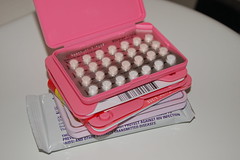
If you take the Pill, do you think receiving a daily text message reminder would help you use the Pill consistently and long-term? If you answered yes, you're in agreement with the results of a study that sought to determine if daily educational text messages affect Pill continuation at 6 months.
Women ages 13 to 24 years electing to use the Pill at an urban family planning clinic were randomized to routine care or routine care and 180 daily educational text messages (the intervention group). There were 968 participants and 6-month continuation data was obtained on 682 (70%):
At 6 months, 54% of intervention participants were taking OC compared to 45% of the routine care group (p<.01). Similarly, 70% of intervention participants were taking OC the last time they had sexual intercourse compared to 61% of the routine care group (p=.03). The intervention group was less likely to report interrupted OC use than the control group (35% vs. 45%, p=.02) and more likely to report consistent OC use (40% vs. 29%, p=.002). The text message group started and finished more packs of OC than the routine care group (p<.05). Women in the intervention group received and read most of the text messages and were satisfied with the number, length and content of the messages.
Overall, the study found that, for the study population (young urban women), the effect of daily educational text message reminders on Pill continuation at 6 months was an improvement of 9% to 11% over the group receiving routine care alone.
On a practical note, I wish there was a Pill app I could recommend so that you could run your own experiment to see if a daily reminder would be helpful to you. I'm aware of a couple (The Pill and iPilule) but, unfortunately, based on anecdotal reports, neither seems ready for prime time yet.
Maybe I should look into developing an iPill app, no? In the meantime, if you know of a good Pill reminder app let me know.
Natazia is the first and only oral contraceptive that contains an estrogen called estradiol valerate and a progestin called dienogest. Estradiol valerate is a synthetic estrogen that is converted to estradiol in a woman’s body....
Until today, all marketed combination oral contraceptives (COCs) contained ethinyl estradiol. With the FDA approval of Natazia, Bayer HealthCare Pharmaceuticals becomes the first company to launch estradiol valerate together with the progestin, dienogest.
So, Natazia contains the estrogen estradiol valerate and the progestin dienogest; the other COCs contain the estrogen ethinyl estradiol and various progestins like, for example, levonorgestrel.
2 dark yellow tablets each containing 3 mg estrogen
5 medium red tablets each containing 2 mg estrogen and 2 mg progestin
17 light yellow tablets each containing 2 mg estrogen and 3 mg progestin
2 dark red tablets each containing 1 mg estrogen
2 white placebo tablets (inert)
Two things to note. First, the placebo interval is reduced to only 2 days. Second, you have 4 days (2 at the beginning and 2 at the end of the active cycle) when you're only taking estrogen pills.
3. It's New.
So, will Natazia's 4-phasic dosage provide the solution to all your past Pill use woes? Eh, I wish, but most likely no. Natazia is just a different Pill brand, not necessarily better or worst than existing brands. How well you do on it will depend on your personal history. Although I haven't seen any data so far to that effect, my guess on what's behind this new dosage regimen is that Bayer will try to gear this brand to the menstrual disorders demographic.
The birth control pill turns 50, people rejoice, and the AP writes an overall good article on the Pill's anniversary.
Two things to keep in mind when you read the article. First:
There are Yaz, Yasmin, Seasonale, Seasonique and Lybrel — all with slightly different packaging, formulations and selling points. Lybrel is the first pill designed to eliminate menstrual periods entirely, although gynecologists say any generic can do the same thing if you skip the placebo and take the active pill every day.
For the bazillionth time, no matter which Pill brand you use, you don't have a menstrual period while on the Pill for the duration of use. All that brands like Lybrel or Seasonale do is they either eliminate or shift the frequency of the withdrawal bleeding episode.
Female doctors use IUDs twice as frequently as the general population of women and many recommend it to their patients.
"The future of birth control is not pills at all," said Dr. Lisa Perriera, 34, of Case Western Reserve School of Medicine in Cleveland.
"The best birth control is easy to use, highly effective at preventing pregnancy and has few side effects," Perriera said. "The methods that fit those criteria best are IUDs and implants. I think that's where birth control is going."
I couldn't agree more with Dr. Perriera. The Pill is a good method of birth control but other methods, the IUD (ParaGard or Mirena) in particular, are far better. Always keep that in mind when deciding which birth control method to use.
Proud mother Carly O'Brien has beaten odds of 11.3 million to one to give birth to two sets of twins - despite being on the contraceptive pill.
The 22-year-old and her partner John Grant, 28, were amazed when she gave birth to her first set of twins Brandon and Daisy.
Now, two years on, Carly has stunned experts by giving birth to another miracle set of twins - Dylan and Lilly.
...
Carly, from Portsmouth, Hants, had been using the contraceptive pill since she was 17 and never imagined she could get pregnant while using it.
She and John, who installs air conditioning units, had been together for only a year and having children had not crossed their minds.
But when Carly missed a period and started being sick, she may be pregnant.
A pregnancy test confirmed it but it wasn't until her 12 week scan she discovered she was carrying twins.
...
New mum Carly was overjoyed with her two children and, certain she did not want any more, she opted for a stronger contraceptive pill, which had to be taken twice a day.
But, just 18 months later, when Carly missed a period she couldn't believe the supposedly impossible had happened again.
A six-week scan revealed she was again carrying twins - beating odds of more than 11 million to one.
She said: 'I just couldn't believe it and didn't know how it could have happened to me again - especially as I was on a stronger pill.
Now, after the first pregnancy while on the Pill, what could Ms. O'Brien have done to lessen the chance of another contraceptive failure?
Option 1: Double-up.
While the simultaneous use of two methods of birth control, for example the Pill and a male condom, sounds great in theory, it can be problematic. A lot of couples, especially those in long-term, monogamous relationships, are not too keen on using a condom; the risk of noncompliance is quite high.
Option 2: Change Birth Control Methods
This is the one I would've advised. When you've already experienced a failure while taking the Pill, and with twins and no desire to become pregnant again it's time to move on to a more reliable birth control method.
For the Pill, the first year typical-use failure is ~8%.
Compare that with the typical-use failure for the most effective methods:
- Implants (Implanon) 0.05% and IUDs (Mirena, CuT) 0.2% and 0.8%, respectively
Evaluating the economic stimulus effect of states using Medicaid money for family planning without the need for a waiver from the Department of Health and Human Services on its merits is not serious business. It's just a sideshow.
- Top Tennessee legislative issues: amend the constitution to restrict pregnant women's access to medical care, and expand gun rights. [Also, taxing the c&@p out of poor smokers, always a worthwhile endeavor.]
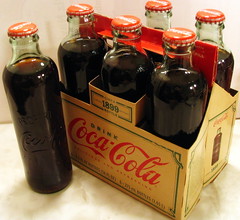
Just because people in the 1950s and 1960s reached for a Coke bottle after sex to use as a spermicide dispenser doesn't mean soft drink douches are an effective method of birth control.
From researcher Deborah J Anderson [yes, she really put a mix of sperm and soda under the microscope and studied it], here are the top eight reasons why, after sex, the soda goes po (you drink it), not pv (you don't spray it into your vagina):
1. Coke's assassin kung fu is weak against sperm.
2. In the race to the cervix, sperm leave Coke in the dust.
3. Unlike Coke and vodka, Coke and vaginal tissue don't mix well.
4. Neither, for that matter, does Coke and vaginal flora.
5. Coke or Pepsi, it doesn't matter. Just get off the soda and say No! to douching.
6. Secret potions have no business being anywhere near your genital region. On the other hand, secret spies might be just the thing to have in the vicinity.
7. Just because you've been drinking out of a bottle since you were a kid and/or you're a Pilates goddess, doesn't mean you have the skills to douche effectively with Coke.
8. A vaginal soda spritzer vs. >80 better methods of birth control. Discuss!
[Did you really, even for a moment, think that US politicians would put the health of women of repro age above the interests of assorted religionists by allowing women to make their own medical decisions? Silly, silly you!]
Two London primary care trusts (PCTs) have received cash to act as pilot sites to see if the scheme is suitable for rolling out across England.
Women will be able to obtain the oral contraceptive after an interview with a qualified pharmacist.
If the pilots are successful, the Pill could be put on the same footing as the morning-after pill, which is already available at pharmacies without direct authorisation from a doctor.
Health minister Lord Darzi insisted last year that "robust" standards would be put in place to ensure that staff were up to the job.
...
A spokeswoman for the Department of Health said: "We will be receiving quarterly updates from SHAs on improving access to contraceptive services and will be working with them to assess the success of the schemes in their areas."
She added: "Any woman who receives contraception from a pharmacy without a prescription can still expect a full consultation with a health professional such as pharmacist or a nurse. We want to improve women's access to contraception and help reduce the number of unintended pregnancies without undermining patient safety."
Needless to say, I think this is a very good idea. Start out small, evaluate as you go along, work out the inevitable kinks and tweak as needed, and see if the intervention has the desired effect. You know, reality-based health care.
The percentage of women who incorrectly self-identified as not contraindicated (6.7%) is similar to the proportion of actual pill users in the US who are contraindicated for use (6%). Over-the-counter provision of COCs [combination Pill] would likely be safe, especially for younger women and if independent blood pressure screening were encouraged.
The sad part is that it's hard to imagine a scenario in this country where science and the female patients' best medical interest would be considered legitimate reasons to make the Pill available over-the-counter.
Q: Which female birth control method is classified by the FDA as a Class 3 Medical Device (more regulation, more expensive to produce), while the corresponding male method is classified as a Class 2 Medical Device (less regulation, cheaper to produce)?
· 92 percent of all women surveyed did not know that 50 percent of unintended pregnancies in the United States occur with couples that used some method of birth control.
· The majority of all women surveyed (64 percent) worry about something having to do with sex. The order of worries is: o Satisfaction (partner and self): 23 percent o Body image: 19 percent o Contracting STDs: 8 percent o Getting pregnant: 6 percent
· Sixty-two percent of all women indicated they discuss birth control with a potential partner.
Women 18–34:
· Four in five (80 percent) women aged 18-34 who currently use birth control say they primarily use it to prevent pregnancy. o Ninety-three percent of women aged 18-34 (both on and off birth control) do not know that half of unintended pregnancies in the United States occur with couples that used some method of birth control.
Women 35-44:
· [S]eventy-one percent of 35- to 44-year-olds surveyed reported never or rarely having difficulty remembering to use their birth control method versus 68 percent of 18- to 34-year-olds.
Current Contraceptive Users:
· Almost half of women who currently use birth control (46 percent) would agree (strongly/somewhat) that they often feel relieved to get their period if they’ve been sexually active.
· Fifty-three percent of women who have ever used hormonal birth control said a physician’s recommendation was among the top five attributes that are most important to them in choosing a birth control method.
· Sixty-two percent of women who currently use a hormonal contraceptive method reported they would agree (strongly/somewhat) that having sex increases their stress levels when they have not used their birth control correctly.
· Seventy-six percent of women who have ever used a hormonal birth control have had concerns about their birth control method.
· Thirty-nine percent of women currently on birth control have used their chosen method for 5 or more years.
· Sixty-three percent of current contraceptive users reported that prevention of pregnancy is their primary reason for using birth control.
· Nearly 80 percent of current contraceptive users (79 percent) agreed (strongly/somewhat) that it is very important to have sex without having to stop and think about birth control.
For me, the most surprising finding of the survey was that a majority of those surveyed did not know that 50% of unintended pregnancies in the United States occur with couples that used some method of birth control. This fact has been known for quite some time and has been well popularized (or so I thought).
So, in the interest of reality-based discussions about birth control, unintended pregnancies, and abortion, your mission, should you choose to accept it, is to go out there and insure that as many people as possible are aware of the fact that ~50% of unintended pregnancies occur in couples who use some method of birth control.
If your method of birth control is the Depo-Provera shot (depot medroxyprogesterone acetate; DMPA), or if you're considering using this method, make sure your physician is aware of the latest ACOG Committee Opinion, in particular:
1. Most of the DMPA bone loss is temporary and is similar to the BMD loss caused by pregnancy and breastfeeding [~3%-5% vs. 2%-8% and 3%-5%].
2. Its use should not be limited to 2 years.
3. Concurrent low-dose estrogen supplementation to slow DMPA bone loss is not recommended.
4. Implants and IUDs--effective, long-term methods of contraception that have no effect on bone density--should also be considered as first-line methods for adolescents.
5. The scientific basis for the 2004 Food and Drug Administration black box warning discouraging the use of DMPA for more than two consecutive years is caca*.
*Okay, that characterization is entirely mine. According to ACOG, the FDA's warning is based on intermediate effects on BMD which may or may not be relevant to increased risk of fracture (former adult DMPA users have BMD rates similar to nonusers) and, while low BMD is linked to an increased risk of fracture in older women, no studies have linked DMPA bone loss with increased rates of fracture in younger women with a low-fracture risk.
N.B. Speaking of Depo-Provera, don't forget you also have a lower-dose version, Depo-subQ, available.
All material, including outside links, is informational. It is not medical advice, diagnosis, or treatment, and it is not intended to replace the advice of your personal health care professional.


 brand on Amazon.

 and
and  . (Note the difference between Next Choice -- two-pill brand -- and Next Choice One Dose -- one-pill brand.)


 ,
, 









![[logo]](http://tbn2.google.com/images?q=tbn:me2GMPeOIa_I_M:http://tcoyp.com/images/squares.gif)


 Books
Books